


Metal Stamping & Punching Services
Ryerson Advanced Processing provides metal stamping and punching services for manufacturers who need high-volume output, repeatable accuracy, and parts that move directly into downstream operations without rework or delay. As a full-service contract manufacturer backed by Ryerson's continental distribution network, we build stamping and punching programs around your production requirements, not the other way around.
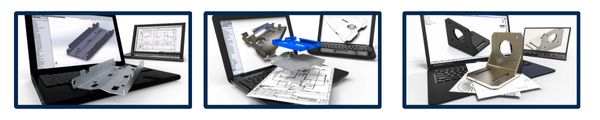
Submit Your Request
Our fabrication pros are here to help reduce time and cost producing your metal parts.
Accepted files include PDF, DXF, DWG, STP
Metal Stamping & Punching Capabilities
Our metal stamping capabilities are engineered for manufacturers running high-volume programs where cycle time, dimensional consistency, and material efficiency are non-negotiable. We operate progressive and transfer die setups suited for complex part geometries, multi-stage forming operations, and tight tolerance requirements across a wide range of metals.
Every stamping program runs under strict process controls and documented quality procedures. Parts come off the line ready for inspection, finishing, or assembly, reducing the handling steps between production and delivery.
Our stamping and punching operations are configured for a broad range of part types, volumes, and material specifications:
- Progressive die stamping for complex, multi-feature parts in continuous strip
- Transfer die stamping for larger blanks requiring independent part transfer between stations
- CNC turret punching for sheet metal hole patterns, cutouts, and formed features
- High-speed punching for repetitive, high-volume production with consistent dimensional output
- Blanking, piercing, coining, embossing, and deep draw operations
- Tight dimensional tolerances across high-volume production runs
- In-process quality checks and end-of-line dimensional verification
- Parts staged for direct transfer into downstream welding, machining, or assembly
Materials We Stamp and Punch
Our metal stamping and punching services accommodate the metals most commonly specified in industrial manufacturing programs:
- Carbon Steel
- Stainless Steel
- Aluminum
- Galvanized Steel
- Cold-Rolled Steel
- Alloy Steel
- Specialty Metals and Alloys

Material sourcing is backed by the Ryerson distribution network which gives us access to 70,000+ metals and alloys with verified traceability and consistent supply, even for large-scale or long-term production programs.
From Stamped Part to Finished Assembly
Metal stamping and punching are frequently one stage in a broader manufacturing sequence. Ryerson Advanced Processing handles what comes next so your parts don't sit waiting on a dock or get shipped to a second vendor for finishing:
- MIG, TIG & Structural Welding
- Press Brake Forming & Plate Rolling
- CNC Machining
- Laser Cutting (Sheet, Plate & Tube)
- Assembly & Sub-Assembly
- Painting & Surface Finishing
- Quality Control & Dimensional Inspection
Managing all of it in-house cuts lead time, eliminates inter-supplier handoffs, and gives your program a single point of accountability from first hit to final shipment.
Why Manufacturers Work with Ryerson Advanced Processing for Stamping & Punching
Volume without variability
Progressive and transfer die setups are optimized for consistent output at scale. Whether you're running thousands of parts per shift or building toward a production ramp, stamped components meet the same dimensional spec run after run.
Material sourcing handled
As part of the Ryerson network, material availability isn't a variable in your production schedule. We source from a distribution network covering 70,000+ metals and alloys which means fewer delays, traceable certifications, and supply continuity for long-running programs.
Full program integration
We're not a job shop that stamps your part and sends it back. Stamping and punching at Ryerson Advanced Processing connect directly into our broader contract manufacturing capabilities such as welding, machining, forming, coating, and assembly so your program stays under one roof and moves on schedule.
Engineering involved from the start
Our engineering team reviews job files before tooling is designed or production begins. We flag design-for-manufacturability issues early, material selection, blank geometry, die clearance, feature placement, so the program runs clean from the first production run, not after costly corrections.
Continental production reach
With more than 100 locations across North America, we assign stamping programs to the facility that makes the most sense for your part, your volume, and your geography. That means shorter freight legs, reduced lead times, and a production setup matched to your supply chain.
Metal Stamping & Punching for Industrial Manufacturers
Ryerson Advanced Processing works with OEMs, mid-size and large manufacturers, industrial fabricators, and supply chain teams across the U.S., Canada, and Mexico who need a stamping and punching partner with the capacity, quality controls, and downstream integration to handle real production programs. We take on the kind of jobs that require a manufacturing partner, complex, multi-stage, high-volume work where getting it right the first time matters.
If your program requires metal stamping or punching alongside welding, machining, assembly, or supply chain management, this is where it gets done.
Request a Quote for Metal Stamping & Punching Services
Upload your job file and tell us what you're building. Our engineering team will review your drawings, evaluate feasibility, and reach out to discuss the production approach. Whether you need prototype quantities or a full production run, we'll scope it honestly and build it right.

Frequently Asked Questions
What types of metal stamping does Ryerson Advanced Processing offer?
We run progressive die and transfer die stamping for high-volume production, along with CNC turret punching for sheet metal features. Our capabilities cover blanking, piercing, coining, embossing, and deep draw operations across a range of materials and part geometries. Our engineering team reviews every job file to determine the right tooling approach for your specific application.
Can you handle metal stamping as part of a larger manufacturing program?
Yes. Stamping and punching at Ryerson Advanced Processing are integrated with our full contract manufacturing capabilities. Stamped parts move directly into welding, CNC machining, forming, assembly, surface finishing, and quality inspection in-house. That end-to-end model is what separates us from standalone stamping shops: your parts don't leave the facility until they're finished.
What tolerances can your metal stamping achieve?
Achievable tolerances depend on material type, part geometry, die setup, and feature complexity. Our engineering team evaluates every submission during the quoting process and confirms dimensional targets based on your specific drawings. For tight-tolerance applications, we can discuss process controls, in-die sensing, and end-of-line inspection procedures as part of the production plan.
Location In-Focus
Our Lavonia, Ga., location has some of the largest stamping presses in the Southeast with the ability to blank and level material up to .375” thick and 60” wide. Presses range from 250 tons up to1600 tons with coil capacity of up to 50,000 pounds and 72” width.

Up To
168”
Length
Up to
72”
Width
Up to
210”
Progressive Dies (wide)

©2026 Ryerson Holding Corporation. All Rights Reserved.